Read the full transcript
JENN:
Welcome back to The Wonder Voice Podcast!
I'm Jenn, and today we're talking about something many parents hear about when their children begin learning to read: reading fluency.
I've always thought that if a child can read quickly, it probably means they're becoming a good reader.
But is that really what reading fluency means?
Because I've seen children read a whole page quite quickly, but when you ask them what happened in the story, they struggle to explain it.
So today, we're asking an important question.
What does it actually mean to be a fluent reader? And how can we help our children become more confident readers without making them feel like reading is a race?
Joining me is Nora Richman, Reading Specialist and founder of Happy Youthful Minds and Wonder Voice.
Nora, welcome back!
NORA:
Thank you, Jenn. I'm so happy we're exploring this topic because reading fluency is one of the most misunderstood parts of learning to read.
And you're absolutely right. Reading quickly does not automatically mean a child is reading fluently.
In fact, a child can read very quickly and still struggle with accuracy, expression, or understanding.
So let's start by changing one common assumption.
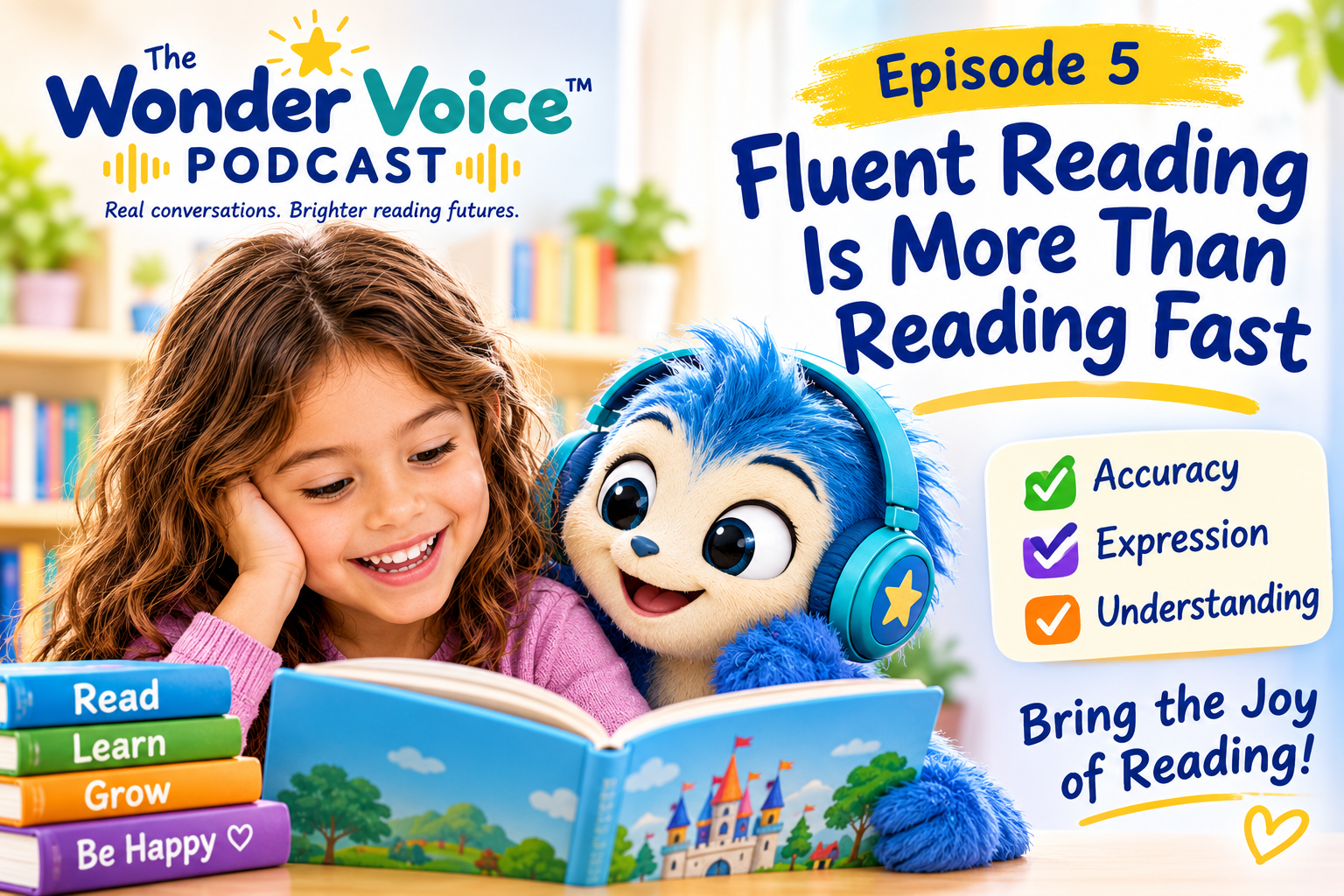
Fluency is not simply about speed.
JENN:
That's interesting. So if speed isn't the main measure, what should parents actually be listening for?
NORA:
Reading fluency is the ability to read connected text accurately, at an appropriate pace, and with expression.
There are three important elements parents should understand.
The first is accuracy.
That means reading the words correctly, rather than frequently guessing, skipping, or replacing words.
The second is automaticity and appropriate rate.
As children develop their reading skills, recognizing familiar words becomes more automatic. They don't have to stop and work out every single word. Their reading begins to flow more naturally.
But automaticity doesn't mean rushing. The pace should support understanding.
And the third element is prosody.
That's a word educators use to describe the expression and rhythm of reading.
It includes things like pausing at punctuation, grouping words into meaningful phrases, and using appropriate intonation.
When a child reads with prosody, the words begin to sound more like natural language.
JENN:
So, if I understand correctly, a fluent reader isn't necessarily the child who finishes the page first.
It's the child who reads the words accurately, at a natural pace, and with expression.
NORA:
Exactly.
Think about how we speak.
We don't usually say every word separately, at exactly the same speed, without pausing.
We group words together. We change our tone. We pause when an idea is complete.
Fluent reading develops some of those same qualities.
And there's another important connection: fluency supports comprehension.
When children become more automatic at recognizing words, they can devote more attention to understanding what they're reading.
But fluency and comprehension are connected skills, not interchangeable ones. A child still needs language knowledge, vocabulary, and opportunities to think about the text.
JENN:
Let's talk about something I think many parents will recognize.
A child reads a paragraph. They get through it quickly, maybe even confidently.
Then you ask, "What was that about?"
And suddenly, there's silence.
Why does that happen?
NORA:
There can be several reasons.
Sometimes a child has learned to focus on getting through the words without really processing their meaning.
They may be reading too quickly, skipping punctuation, or using a familiar rhythm without thinking about the message.
In other cases, the text may contain vocabulary, sentence structures, or ideas that are unfamiliar to them.
And sometimes the child can decode the words but has not yet developed enough language comprehension or background knowledge to understand the passage.
Remember, reading comprehension is not automatic just because a child can pronounce the words.
JENN:
So a child might be able to say all the words correctly, but still not understand what those words are telling them?
NORA:
That's right.
Let's imagine a sentence:
"The little rabbit hurried beneath the bushes when the storm began."
A child might read every word correctly.
But do they understand what "hurried" means? Do they understand what "beneath" means? Can they picture what happened?
Can they explain why the rabbit went beneath the bushes?
Those questions help us explore whether the child is making meaning from the text.
JENN:
I love that distinction.
Instead of just asking, "Did you read the sentence correctly?" we can also ask, "What did you imagine when you heard that sentence?"
NORA:
Exactly.
We want children to experience reading as meaning-making, not simply saying printed words out loud.
JENN:
What should parents look for when listening to their child read?
Are there signs that fluency is developing?
NORA:
Absolutely. Here are some things parents can listen for.
First, accuracy.
Is your child reading familiar words correctly? Are they using the letters and spelling patterns rather than relying entirely on pictures or guesses?
Second, fewer unnecessary pauses.
As word recognition becomes more automatic, children generally need less effort to work through familiar words.
Third, phrasing.
Instead of reading one word at a time, can your child begin grouping words into meaningful phrases?
For example, rather than reading:
"The little... girl... opened... the door..."
They may gradually read:
"The little girl / opened the door."
Fourth, expression.
Does your child begin to notice question marks, exclamation marks, and the feelings or meaning in the sentence?
And fifth, understanding.
Can they tell you what happened, describe a character, answer a question, or connect an idea from the text to something they already know?
These are useful observations, but remember that fluency develops over time.
A child may show strength in one area while still developing another.
JENN:
That's helpful because sometimes parents compare their children with other children.
One child reads a page in two minutes, another takes four minutes, and suddenly everyone starts worrying about who's ahead.
NORA:
And that's exactly why we need to be careful.
Children develop at different rates, and reading pace should always be considered in relation to accuracy, the difficulty of the text, the child's stage of development, and comprehension.
A stopwatch cannot tell you the whole story of a child's reading development.
JENN:
Let's make this practical.
If a parent wants to help their child become a more fluent reader, where should they start?
NORA:
The first thing I recommend is to make sure the reading material matches the child's current reading skills.
If the text is too difficult, the child may spend so much effort decoding unfamiliar words that fluency becomes very challenging.
Choose a passage or story where your child can practice successfully, with a manageable amount of new learning.
Then, try these strategies.
Strategy number one: Model fluent reading.
Read aloud to your child.
Let them hear what natural reading sounds like.
Show them how your voice changes, where you pause, and how you bring a character or moment in the story to life.
Children need to hear fluent reading before they can fully reproduce it themselves.
JENN:
So story time is actually a great opportunity to demonstrate fluency.
NORA:
Absolutely.
And that brings us to strategy number two: echo reading.
You read a sentence or short passage first, and then your child reads the same section after you.
They hear the phrasing and expression, and then they have an opportunity to try it themselves.
You can make it feel like a shared reading experience rather than a lesson.
Strategy number three: read together.
This is sometimes called choral reading.
You and your child read the same words aloud together.
It can help a child feel supported, especially when they are not yet confident reading independently.
JENN:
I can see how that would take away some of the pressure.
The child isn't suddenly expected to do everything alone.
NORA:
Exactly.
Strategy number four: reread familiar passages.
Repeated reading can help children become more familiar with words and develop smoother, more accurate reading.
Choose a short passage your child has already practiced.
Read it together, talk about it, and revisit it another time.
The goal isn't to see how many seconds they can shave off.
The goal is to notice whether the reading becomes more accurate, more natural, and more meaningful.
Strategy number five: practice reading in meaningful phrases.
Some children read word by word because they haven't yet developed the habit of grouping words together.
You can model a sentence in short phrases.
For example:
"The dog ran across the garden."
You might demonstrate:
"The dog ran / across the garden."
Then read the complete sentence naturally.
Help your child notice how the words belong together.
Strategy number six: talk about what you read.
Pause and ask a simple question.
"What happened?"
"Why do you think the character did that?"
"What do you think might happen next?"
You don't need to interrupt every sentence. A natural conversation about the story can help connect reading with meaning.
And finally, strategy number seven: keep the experience positive.
Notice effort, improvement, and the strategies your child is using.
If they get stuck, offer a helpful prompt or model the word.
Avoid making every reading session a correction exercise.
Children need enough practice to develop their skills, but they also need to feel comfortable exploring stories.
JENN:
I want to ask about something I hear quite often.
Schools sometimes measure reading fluency using timed reading activities.
Does that mean parents should time their children at home?
NORA:
Timed reading can be useful as one part of a structured assessment or progress-monitoring approach when it is used appropriately.
Educators may look at the number of words read correctly within a set period, alongside accuracy and other information.
But I would not recommend turning everyday reading at home into a race.
If a child becomes focused on reading faster, they may rush, guess words, ignore punctuation, or become anxious about making mistakes.
And that can take the joy out of reading.
Parents can certainly notice whether reading is becoming smoother over time.
But the most useful question is not simply, "How fast did you read?"
It's:
"Are you reading more accurately?"
"Are you recognizing words more easily?"
"Are you beginning to read in meaningful phrases?"
"Can you tell me what the story is about?"
Those observations give us a much richer picture.
JENN:
So we shouldn't confuse a faster reading rate with better reading.
NORA:
Exactly.
We want children to become accurate, increasingly automatic, expressive readers who understand what they read.
Speed alone is not the destination.
JENN:
What about children who continue to read word by word?
They know many letter sounds, they can decode simple words, but their reading still sounds slow and choppy.
Should parents be concerned?
NORA:
First, it is important to look at the child's overall reading development.
Reading word by word may be expected while a child is learning to decode. They are still working through the words, and that takes effort.
But as foundational skills become more secure, we generally want to see word recognition becoming increasingly automatic and reading becoming smoother.
If a child continues to struggle, we should look at what may be getting in the way.
Do they have difficulty decoding unfamiliar words?
Are they still working hard to recognize common spelling patterns?
Are they reading text that is too difficult?
Do they need more opportunities to hear fluent reading and practice with appropriate material?
And are there broader language comprehension or vocabulary needs?
These questions help us identify the next instructional step.
If the difficulty persists despite appropriate instruction and practice, parents should speak with their child's teacher or a qualified reading specialist.
It is much more helpful to understand which skills need support than to simply tell a child to read faster.
JENN:
I think that's such an important message.
Instead of saying, "Come on, read faster," we can ask, "What part of reading is still difficult, and how can I help?"
NORA:
Exactly.
We want to support the skill, not put pressure on the child.
JENN:
Nora, something you've mentioned throughout this conversation is keeping reading enjoyable.
And I think that's important because reading practice can sometimes become repetitive.
A child reads a passage, gets corrected, reads it again, and eventually doesn't want to pick up the book.
How do we keep that connection with stories alive while still helping children build foundational reading skills?
NORA:
I believe we need to bring two things together.
The foundations of reading and the happiness of story time.
Children need explicit instruction and purposeful practice. They also need opportunities to enjoy language, imagine, ask questions, and connect with the stories they hear and read.
Story time can be much more than an adult reading while a child listens.
It can be a conversation.
You can pause and ask what a character might be thinking.
You can explore a new word.
You can wonder what happens next.
You can read a sentence together, laugh at a funny moment, or revisit a favorite page.
These experiences help children see reading as something meaningful.
And when children are ready to practice reading independently, we can support them without losing that sense of curiosity.
JENN:
That's a lovely way to think about it.
It's not about choosing between learning and enjoyment.
It's about creating experiences where both can happen.
NORA:
Exactly.
And this is one of the ideas behind Wonder Voice.
We asked a simple question:
What if your child could talk to a story?
What if a child could listen, read aloud, ask questions, explore words, and interact with a reading companion during story time?
Through Wonder Voice, children can engage with stories and reading activities alongside WONZY, an interactive reading companion.
And the Reading Mastery Propellor is designed to use available reading evidence to help inform meaningful insights about a child's reading development.
For parents, the aim is to make the reading journey easier to understand.
Not just whether a child finished a story, but what they have been practicing, what they are developing, and where they may benefit from further support.
JENN:
So the experience isn't just about completing another reading exercise.
It's about giving children opportunities to interact with stories while helping parents understand more about their reading journey.
NORA:
That's exactly the idea.
Because every reading experience can create an opportunity to learn, practice, and grow.
JENN:
Let's bring everything together.
Today we've learned that reading fluency is much more than reading quickly.
It's about reading accurately, recognizing words with increasing automaticity, using natural expression, and making meaning from what we read.
And for parents, the message is simple.
Don't turn reading into a race.
Listen to how your child reads.
Notice the progress.
Read aloud together.
Practice with appropriate stories and passages.
And give your child opportunities to talk about what they've read.
Nora, thank you for helping us understand why fluent reading is about so much more than speed.
NORA:
Thank you, Jenn.
And I want to leave parents with one thought.
When your child reads, listen beyond the number of words they can read in a minute.
Listen for the connections they are making.
Listen for the confidence that is growing.
Listen for the expression in their voice.
And most importantly, listen for the meaning they are discovering.
Every child deserves the opportunity to become a confident reader, one meaningful reading experience at a time.
JENN:
Beautifully said.
Thank you for joining us for another episode of The Wonder Voice Podcast.
If you enjoyed today's conversation, share it with another parent or educator who wants to better understand how children learn to read.
And discover Wonder Voice, where WONZY and the Reading Mastery Propellor bring interactive storytelling, reading practice, and meaningful parent insights together.
Because reading is more than getting through the words.
It's about discovering what those words can mean.
I'm Jenn, and we'll see you next time!
NORA:
Happy reading!
JENN:
And remember: bring the happiness of story time back!