
What Can Reading Aloud Tell You?
Episode 2For parentsReading education6:38September 1, 2026
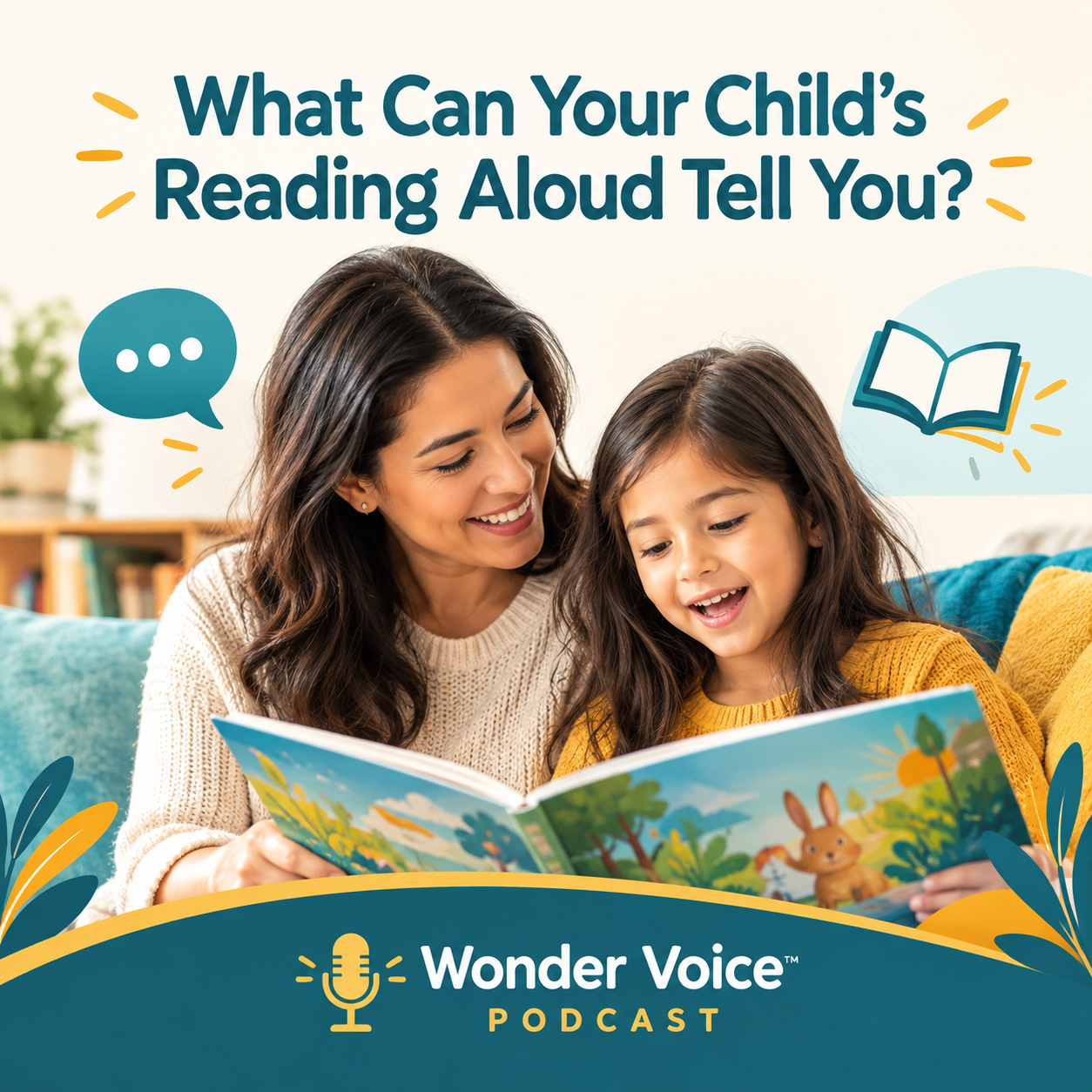
What can I learn about my child's reading development by listening to them read aloud?
The short answer
Reading aloud can reveal how your child recognizes words, uses letter-sound patterns, reads with accuracy and expression, understands vocabulary, and makes sense of a story. Listen patiently, notice patterns rather than isolated mistakes, and ask gentle questions about meaning. If difficulties persist, discuss your observations with your child’s teacher.
Discover what reading aloud can reveal about your child's accuracy, fluency, vocabulary, comprehension, and confidence, plus practical ways to support progress.
Key takeaways
- 1. Reading aloud can offer clues about word recognition, decoding, fluency, and comprehension.
- 2. Fluent reading involves accuracy, an appropriate pace, and expression, not simply reading quickly.
- 3. A child may pronounce words accurately but still need support understanding vocabulary or the story.
- 4. Give your child time to work through an unfamiliar word before stepping in.
- Supportive conversations and regular shared reading can help parents understand what their child is learning.
Show notes
When children read aloud, parents can learn much more than whether they pronounce the words correctly. Their reading can offer clues about decoding, fluency, vocabulary, comprehension, and confidence.
In this episode, host Jenn speaks with Nora Richman about what parents can notice during everyday reading, how to ask supportive questions, and how to make reading together a positive experience without turning every story into a test.
You'll learn why patience matters, how to invite conversations about stories, and when a reading difficulty may be worth discussing with your child's teacher.
Wonder Voice™ brings interactive reading into this journey through WONZY™, with the Reading Mastery Propellor™ designed to help translate reading experiences into meaningful progress insights.
Episode transcript
Read the full transcript
Jenn: Welcome to the Wonder Voice™ Podcast, where we help parents understand reading development and find practical ways to support children as they grow into confident readers. Today, we're exploring a simple question: What can your child's reading aloud tell you?
Nora Richman: Reading aloud gives parents a window into several parts of reading development. You can notice how a child recognizes words, works through unfamiliar ones, reads sentences, understands vocabulary, and makes sense of a story. You don't need to turn reading time into a formal test. Often, listening calmly and asking a few thoughtful questions can tell you quite a lot.
Jenn: Let's start with word reading. What should parents notice?
Nora: Pay attention to how your child approaches an unfamiliar word. Do they look at the letters? Do they try to connect letters with sounds? Do they guess from the picture or the first letter? Pictures and context can help with meaning, but children also need to develop reliable ways to recognize and decode the words on the page.
One mistake doesn't tell you everything. Look for patterns over time. If your child regularly struggles with certain spelling patterns or needs a lot of help with familiar words, that may be useful information to share with their teacher.
Jenn: What about fluency? Parents sometimes think fluent reading simply means reading fast.
Nora: Fluency is more than speed. It includes accuracy, a reasonable pace, and expression. A child who reads every word very slowly may be using so much effort to identify words that there is less attention available for meaning. A child who rushes may skip words or overlook punctuation.
Listen for reading that becomes smoother and more natural as skills develop. And remember that a difficult passage may sound less fluent than an easy, familiar one. The text matters, too.
Jenn: Can a child read the words correctly but still struggle with understanding?
Nora: Yes. Word reading and language comprehension are related, but they are not the same thing. A child might pronounce every word in a paragraph and still be unsure what the paragraph means. Vocabulary, background knowledge, sentence structure, and the ability to connect ideas all contribute to understanding.
After a short section, try asking, “What happened?” or “Why do you think the character did that?” Give your child time to think. If they aren't sure, return to the text and explore the answer together.
Jenn: What if a child comes across a word they don't know?
Nora: First, pause and give them a little time. If it is a word they can work out using the letter-sound patterns they know, encourage them to try. You might say, “Let's look at the letters,” or “What sound does this part make?”
If the word is not decodable using their current knowledge, or they remain stuck, tell them the word without making it a big deal. Then reread the sentence together so they can reconnect the word with its meaning.
The goal isn't to make children struggle indefinitely. It's to help them learn strategies while keeping reading a positive experience.
Jenn: What can parents learn from the questions their children ask during a story?
Nora: Questions can reveal curiosity, vocabulary needs, connections to prior knowledge, and what a child is trying to understand. When a child asks what a word means, take a moment to explain it in child-friendly language. When they wonder why something happened, use the story to explore possible answers.
Conversation is an important part of reading together. Children don't have to wait until the end of a book to talk about what they're thinking.
Jenn: And what about confidence? Can that show up during reading?
Nora: Certainly. Some children eagerly try unfamiliar words. Others become quiet, rush, or ask for help quickly because they are worried about making a mistake. These behaviours do not tell you a child's ability on their own, but they can help you understand how reading feels to them.
Offer specific encouragement. Instead of saying only, “You're so smart,” you could say, “You looked carefully at the word and tried the sounds.” That recognizes the strategy and effort your child used.
Jenn: If parents notice a recurring difficulty, what should they do next?
Nora: Keep brief, neutral observations. You might notice that your child often struggles to blend sounds, loses their place, or can read a passage but finds it difficult to retell. Share those observations with the teacher and ask what they are seeing at school and what practice would help.
A single reading session cannot diagnose a learning difficulty. If concerns persist, working with the teacher can help you understand whether additional assessment or targeted instruction may be appropriate.
Jenn: How does Wonder Voice™ fit into this picture?
Nora: Wonder Voice™ is designed to make reading more interactive through WONZY™, which can read with children, listen as they read, and engage them in story-related conversation. The Reading Mastery Propellor™ is intended to turn reading experiences and available evidence into useful progress insights for parents.
The important point is that technology should support the reading journey, not replace the relationship between a child, their family, and their educators. Parents need understandable information that helps them decide what to do next.
Jenn: Let's finish with one practical suggestion for families listening today.
Nora: Choose a book your child enjoys. Take turns reading when that feels helpful. Give them time to work through words, talk about interesting ideas, and ask what they think might happen next. You don't need to catch every mistake. Stay curious about what your child understands and where they might need support.
Jenn: Wonderful advice. Reading aloud isn't just about getting to the last page. It's an opportunity to listen, connect, and discover what your child is learning. Thanks for joining us on the Wonder Voice™ Podcast.
Nora: Thank you. Remember, every reading moment can help you understand your child a little better.
Sources & references
- Reading Rockets, “Reading with Your Child”: https://www.readingrockets.org/literacy-home/reading-your-child
- Reading Rockets, “Reading 101 for Parents: Fluency”: https://www.readingrockets.org/literacy-home/reading-101-guide-parents/reading-basics/fluency
- Reading Rockets, “Reading Aloud to Build Comprehension”: https://www.readingrockets.org/topics/about-reading/articles/reading-aloud-build-comprehension
- Wonder Voice™: https://wondervoice.ai