Read the full transcript
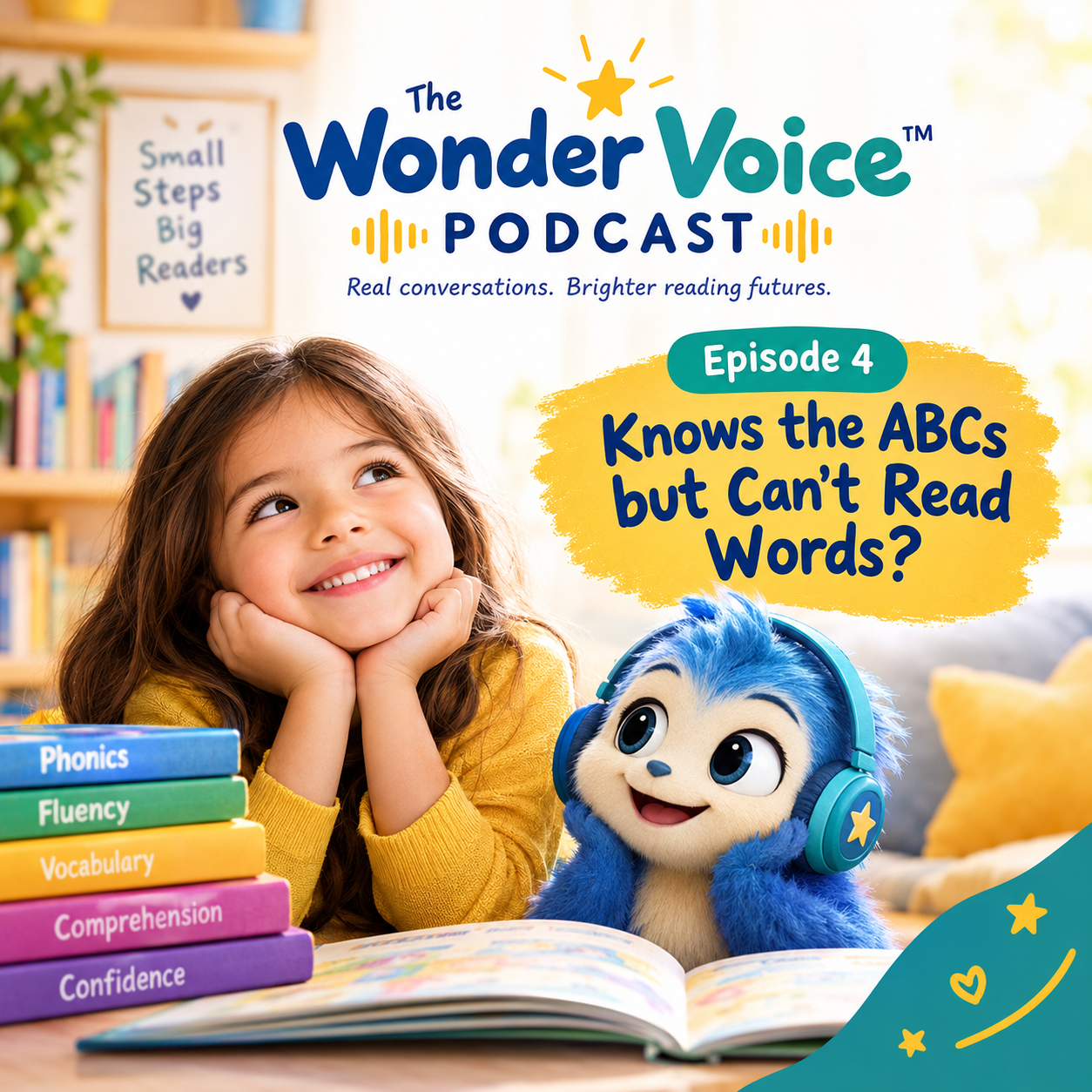
Episode 4: My Child Knows Their Letters but Can't Read Words. Why?
Jenn: Welcome back to The Wonder Voice™ Podcast, where we're exploring how children learn to read and how we can support them while keeping the joy of story time alive. I'm Jenn, and today we're talking about something many parents experience.
Your child knows their ABCs. They can point to letters, name them, and maybe even sing the alphabet song perfectly. But then you open a book, point to a simple word, and ask them to read it. Suddenly, they're stuck.
Why does that happen? And what can you do to help?
Nora, let's start with the big question. If a child knows their letters, why can't they read words?
Nora: This is such an important question, Jenn, because many parents understandably think that learning the alphabet is the same as learning to read.
But recognizing letters is just one part of the process.
Imagine a child sees the letter M and says, "That's M!" Wonderful. They recognize the letter name. But to read the word "mat," they also need to know the sound represented by M, connect it with the sounds represented by A and T, and blend those sounds together to read the whole word.
Knowing the letter's name doesn't automatically mean the child can use that letter to decode a word.
Jenn: So a child can know the alphabet and still need help with the actual process of reading?
Nora: Exactly. And it helps to understand three connected skills: letter recognition, letter-sound knowledge, and blending.
Letter recognition means identifying a printed letter. Letter-sound knowledge means connecting that letter with the sound it represents. Blending means putting individual sounds together to read a word.
Children need opportunities to develop these skills and connect them through explicit instruction and practice.
Jenn: Let's make that practical. What does blending actually look like?
Nora: Let's use the word "sat."
A child learning to read might first identify the letters S, A, and T. They need to know the sounds those letters represent in this word: /s/, /ă/, and /t/.
Then they learn to blend those sounds together to read "sat."
At first, blending can feel slow. A child might say each sound separately and struggle to bring them together. That's a normal part of learning for some children.
With appropriate instruction and practice, blending can become smoother and more automatic.
Jenn: What if the child can say the individual sounds but still can't put them together?
Nora: That's a useful observation. It suggests the child may need more guided practice with blending.
You can begin with simple words made from sound-letter patterns the child has already learned. Model the process, invite the child to try, and gradually give them more responsibility.
You might say, "Let's look at this word together. What sound does this letter make? And this one? Now let's put those sounds together."
Keep the pace comfortable. If the child becomes frustrated, model the word and return to practice later.
And remember, not every word follows the same simple pattern. English has many spelling patterns, so children need instruction that builds gradually rather than expecting them to figure everything out independently.
Jenn: That brings me to something I hear from parents all the time. Their child looks at a word, glances at the picture, and guesses what the word says.
For example, they see a picture of a cat and guess "cat," even if the printed word is something else.
Is that a concern?
Nora: It's worth paying attention to, but we don't want to panic over one guess.
Pictures, context, and prior knowledge all help us understand stories. They're valuable. The concern is when a child consistently relies on pictures or guesses instead of attending to the letters and using the sound patterns they've learned.
If the word is "dog," for example, encourage your child to look at the printed word and think about the sounds represented by D, O, and G.
You can say, "Let's look at the word. What do you notice about the letters?"
The goal isn't to turn every reading moment into a test. It's to gently direct the child's attention to the print and help them build the skills needed to read unfamiliar words.
Jenn: So we don't need to cover up every picture or stop enjoying illustrated books.
Nora: Absolutely not! Pictures are part of the joy of children's books. We want children to enjoy the illustrations, imagine what's happening, and talk about the story.
We simply want to make sure that when we're practicing reading words, we're also helping them look at the letters and use the skills they're learning.
Story time and foundational reading instruction can complement each other.
Jenn: Let's talk about letter sounds. Some parents aren't sure how to teach them, especially when a letter can represent different sounds in different words.
Where should they begin?
Nora: Start with the letter-sound relationships your child is learning at school or through their reading program. Practice a small set of familiar letters and sounds, then use those sounds in simple words the child is ready to read.
For example, if your child has learned the sounds for S, A, and T, you might practice reading "sat" or "at," depending on the instruction they've received.
It's important to remember that the goal is not to memorize a huge list of sounds all at once. The goal is to connect what the child knows about letters with the actual process of reading words.
And when you model individual consonant sounds, try to avoid adding an extra vowel sound. For example, model /m/, rather than saying "muh." Adding an extra vowel can make it harder for children to blend the sounds together.
Jenn: That's a helpful detail. Now, where does phonemic awareness fit into this?
Nora: Phonemic awareness is the ability to hear and work with individual sounds in spoken words. For example, a child might hear the word "sun" and learn to notice that it contains three sounds: /s/, /ŭ/, and /n/.
This is different from looking at the printed letters. Phonemic awareness focuses on the sounds in spoken language, while phonics connects sounds with letters and spelling patterns.
Both matter. Children benefit from opportunities to hear and work with sounds as they learn to connect those sounds to print.
Jenn: What are a few things parents can try at home without turning reading into a battle?
Nora: I would start with three simple ideas.
First, keep practice short and focused. A few minutes working with words that match the child's current learning can be more helpful than a long session that leaves everyone exhausted.
Second, model the process. If your child gets stuck, guide them to look at the letters, think about the sounds they've learned, and try blending. If they need help, show them how to read the word. You don't need to withhold the answer to make them learn.
Third, celebrate effort and progress without making every word a performance. You might say, "You looked carefully at the letters," or "You worked hard to put those sounds together."
And then keep reading stories together. Talk about the characters. Ask what your child thinks might happen next. Enjoy the illustrations and the language.
Jenn: I love that last point because it brings us back to the happiness of story time.
Sometimes, when parents become worried about reading, every book starts to feel like an assessment. They stop enjoying the story because they're watching every word their child reads.
Nora: That's understandable. Parents want to help, and they may be worried that their child is falling behind.
But children need both purposeful reading instruction and positive experiences with books.
A story can invite curiosity, imagination, conversation, and discovery. A child can ask what a word means, wonder why a character did something, or make a connection with their own life.
Those moments help make reading meaningful. And we can create opportunities to practice foundational skills without losing the warmth and joy that make children want to come back to books.
Jenn: That's actually one of the ideas behind Wonder Voice™. We want to bring the happiness of story time and the foundations of reading together.
Through WONZY™, children can interact with stories, ask questions, explore words, and practice reading in an engaging experience. And the Reading Mastery Propellor™ is designed to help turn available reading evidence into meaningful insights for parents.
The idea is to make the reading experience itself more interactive while helping families better understand the child's progress.
Nora: Exactly. Technology should support the learning experience, not take away the joy of the story or replace the important role of parents and educators.
And no single activity tells us everything about a child's reading ability. We need to look at what the child can do across appropriate tasks and experiences, and use that information to decide what support may help next.
Jenn: Before we wrap up, let's leave parents with one important reminder.
If your child knows their letters but struggles to read words, it doesn't automatically mean they're lazy, not paying attention, or incapable of learning to read.
They may need more support connecting letters to sounds, hearing sounds within words, blending sounds, or applying those skills when they see printed words.
Nora: That's right. Start by noticing what your child can already do. Then build from there, with appropriate instruction, manageable practice, and encouragement.
And if the difficulty persists or you're concerned about your child's progress, talk with their teacher or a qualified reading specialist. They can help identify the specific skills that need further support.
Jenn: Thank you, Nora.
And to our listeners, remember: reading is a journey, and children don't all master every skill at the same pace. Keep asking questions, keep supporting their growth, and keep making room for the happiness of story time.
Thank you for listening to The Wonder Voice™ Podcast. Join us next time as we continue exploring how children learn to read and how we can help them grow into confident readers.
Until then, keep reading, keep wondering, and keep the joy in the story.